
How this calorie calculator works
The calculator works in two steps. First it estimates your BMR, the calories your body burns at complete rest, using the Mifflin-St Jeor equation. Studies have found it to be one of the most reliable formulas for healthy adults.
Men
BMR = 10 × weight (kg) + 6.25 × height (cm) − 5 × age + 5
Women
BMR = 10 × weight (kg) + 6.25 × height (cm) − 5 × age − 161
Then it multiplies your BMR by an activity factor to get your TDEE (total daily energy expenditure). That is your maintenance number: eat about this much and your weight should stay roughly the same.
| Activity level | What it means | Factor |
|---|---|---|
| Sedentary | Desk job, little exercise | × 1.2 |
| Lightly active | Exercise 1–3 days a week | × 1.375 |
| Moderately active | Exercise 3–5 days a week | × 1.55 |
| Active | Exercise 6–7 days a week | × 1.725 |
| Very active | Hard training or a physical job | × 1.9 |
Be honest here. Most people overestimate how active they are, and picking one level too high can add 200 to 300 calories a day to your number.
Using your number to lose weight
To lose weight you need to eat a little less than your TDEE. A deficit of around 500 calories a day is a common starting point and typically leads to about 0.5 kg (1 lb) a week at first, in line with CDC advice to aim for 0.5 to 1 kg (1 to 2 lb) a week.
Two things to know. Weight loss slows over time, because a smaller body burns fewer calories, so recalculate every few kilos. And the calculator never suggests going below about 1,200 calories a day for women or 1,500 for men, which is hard to do without missing nutrients. For the full walkthrough, read how many calories should I eat to lose weight?
Your macros
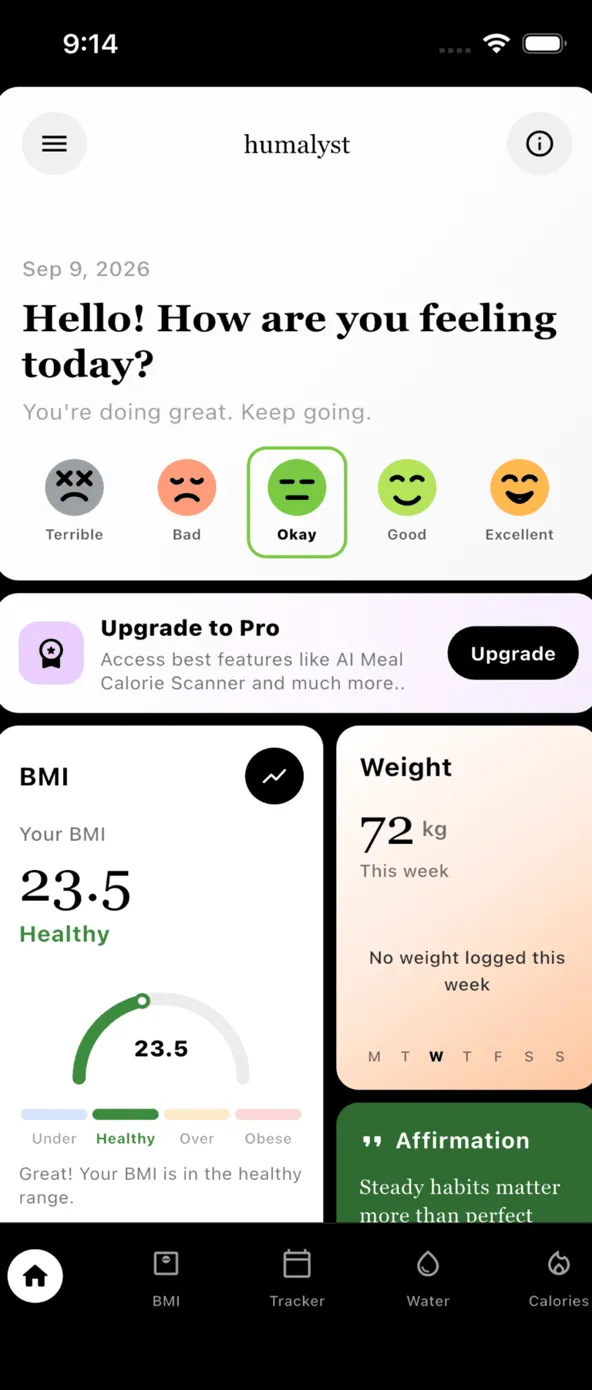
The macro split matches the Humalyst app: 25% protein, 45% carbohydrate and 30% fat, which sits comfortably inside the ranges the US National Academies recommend for adults, plus about 14 g of fibre per 1,000 calories. Protein has 4 calories per gram, carbs 4 and fat 9.
If you lift weights or are losing weight, more protein can help you keep muscle. Our guide tohow much protein you need per day breaks it down by weight, age and goal.
Make the estimate fit you
- Start with the number above for two to three weeks.
- Log what you eat honestly, including oils, sauces and drinks. These are where most hidden calories live (see how to count calories accurately).
- Weigh yourself a few times a week and look at the weekly average, not single days.
- Adjust by 100 to 200 calories if your weight is moving faster or slower than you want.
Frequently asked questions
How many calories should I eat a day?
It depends on your sex, age, height, weight and how active you are. Most adults land somewhere between about 1,800 and 3,000 calories a day to maintain their weight. The calculator above estimates your personal number using the Mifflin-St Jeor equation.
What is the difference between BMR and TDEE?
BMR (basal metabolic rate) is the energy your body uses at complete rest. TDEE (total daily energy expenditure) adds everything you do on top: walking, working, exercising and digesting food. TDEE is your maintenance calories.
How many calories should I eat to lose weight?
A daily deficit of about 500 calories below maintenance is a common, sustainable starting point and usually leads to around 0.5 kg (1 lb) of loss a week at first. Progress tends to slow over time as your body adapts, so recheck your numbers every few kilos.
How accurate is this calorie calculator?
Mifflin-St Jeor is one of the most accurate equations for healthy adults, but any formula is an estimate and individuals can differ by 10% or more. Treat the result as a starting point, track your weight for two to three weeks, then adjust.
What is the lowest number of calories I should eat?
Without medical supervision, most guidance suggests not going below about 1,200 calories a day for women or 1,500 for men, because it becomes hard to get enough nutrients. This calculator never suggests a target below those floors.
Sources
- Mifflin et al. A new predictive equation for resting energy expenditure (1990)
- NHS: Understanding calories
- CDC: Losing weight
- Hall et al. Quantification of the effect of energy imbalance on bodyweight (The Lancet, 2011)
- Harvard Health: Calorie counting made easy
- National Academies: Dietary Reference Intakes for macronutrients
This page is general information, not medical advice. Results are estimates. If you have a health condition, are pregnant, or are making a big change to how you eat or drink, talk to a doctor or registered dietitian first.